Snake Eating Apple Game: How to Clear All 25 Apples
To clear all 25 apples, plan the turn after each bite before you take it. A solid wall, a block or your own body ends the round. The apples appear in random empty cells, so the winning pattern is to keep an escape lane and recheck the board at each milestone. Open the Snake Eating Apple Game and try the first five apples with that one rule in mind.
Start with an exit route
Think of an apple as a turn you need to prepare for, rather than the end of a route. Look at the cells on its left and right relative to your direction of travel. If you can see an open side and an open square after it, you can eat and turn away with room to correct. If both sides are blocked and the square ahead leads into a wall, change your approach before entering that lane. You cannot reverse immediately, and every apple adds a segment to the line following you.
A useful opening loop uses two lanes through the middle and one turn close to each end. You can leave it to pick up an apple, then use a parallel lane to come back. Give the loop enough width that your head and tail are not racing toward the same corner. The board is only 20 cells wide and 14 high, so a tight loop runs out of space much earlier than it looks from the first three segments.
How to change your route at each milestone
| Apple count | What changes | Next decision |
|---|---|---|
| 5 | First block if space allows. 165 ms per step with one block. | Scan the opposite side before using your original loop again. |
| 10 | Second possible block. 155 ms per step with two. | Choose a second lane around any corner where the first two blocks meet your body. |
| 15 | Third possible block. 145 ms per step with three. | Keep long runs open. Avoid turns into gaps that only have one exit. |
| 20 | Fourth possible block. 135 ms per step with four. | Take a wider route if the straight line to an apple closes behind your growing tail. |
| 25 | Final placement attempt and immediate clear. | Make a safe approach to the final apple. The game ends on the bite. |
The game looks for the farthest eligible free cell measured along rows and columns. The cell must be at least three grid steps from your head and cannot sit directly next to any segment. A block cannot move once placed. It might be far away at first but close the exact lane you were planning to use next. If there is no eligible cell, that placement is skipped and the speed only reflects the blocks actually placed.
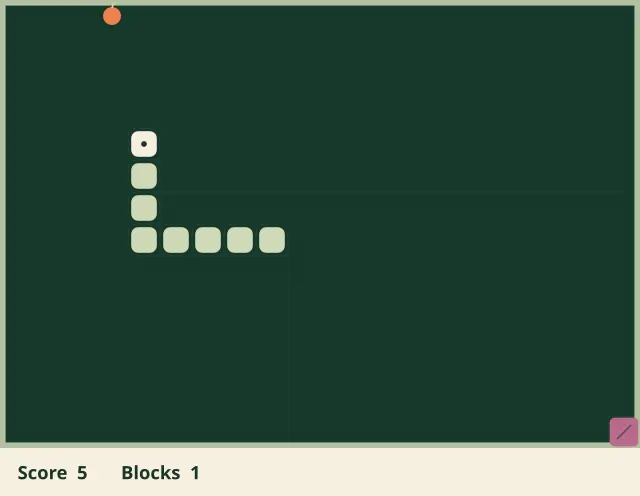
Turn along a wall with room to leave
If an apple sits on the far right edge and you are moving right, check the cells above and below it while you still have a few steps to go. Choose one as the exit. Keep moving toward the apple, then take that turn as soon as you reach it. If both exits are blocked, approach from above or below so you can turn back toward the center after the bite. An apple in a literal corner has only one legal exit for any given approach, so check the exit lane before committing.
On the later stages, make the steering decision a cell earlier. The input goes through a short turn queue, so a single deliberate direction press is easier to predict than pressing the same turn several times and then trying to correct it. On a phone, swipe or tap the arrow buttons. Press P or tap Pause if you want to study the board, then resume with your next turn in mind.
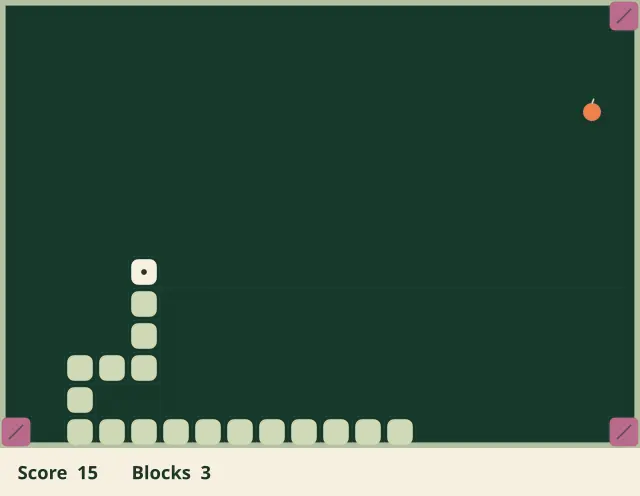
A route to practice for apples 21 through 25
- Find a long safe lane. Pick a row or column with several empty cells and an open exit at the far end. Use it to pull the body into a predictable shape.
- Take the apple from the open side. If eating from the nearest side sends you into a single-cell pocket, go around and enter from an angle that leaves a turn.
- Clear the junction before taking a shortcut. Watch the tail leave a crossing before threading back into it. If you are unsure which segment moves next, stay on the longer route.
- Check where the next apple appears. Repeat the scan after each bite. A previously open lane can close when that bite adds a segment, even between milestones.
A route that crosses the same junction twice in quick succession is usually the one to reconsider. The second pass arrives while part of the tail is still moving through. A longer loop gives the tail several extra steps to clear the junction. You can practice that timing on early apples, when the board is slower and you have more space to recover.
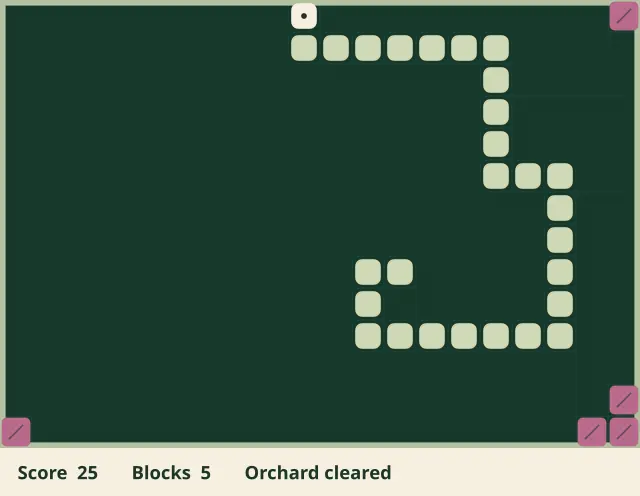
One example route from the last five apples
These direction sequences are from the recorded board above. Each number is a count of cells to travel before turning. The game rolls new apple positions each run, so use the sequence to see how this run kept the approach open.
| Next apple | Route from the previous apple |
|---|---|
| 21 | Left 1, down 3, right 10, down 3 |
| 22 | Left 2, up 1 |
| 23 | Left 3, down 2 |
| 24 | Right 6, up 5, left 2, up 4 |
| 25 | Left 6, up 1 |
Keep the next run simple
If you hit a wall, work on choosing the exit before a border apple. If a block got you, change the lane you take immediately after a milestone. If you bit the tail, widen the loop that brought you back to it. The game keeps a best apple count, so you can judge whether one change helps across several runs.
Play the 25-apple challenge or compare the three Snake Eating Games. If you want to work on tail timing on a board with wrapping edges, use the Fruit Snake wrapping guide.