Snake Eating Games: Classic, Fruit and Apple
Compare the three snake games on this site. The classic Snake Eating Game uses solid walls and an ever-growing tail. Snake Eating Fruit Game has wrapping edges and multiple fruit types. Snake Eating Apple Game keeps the solid walls but adds a new block every five apples and a finish line at twenty-five. All three feature a snake that grows as it eats, but they reward different route choices.
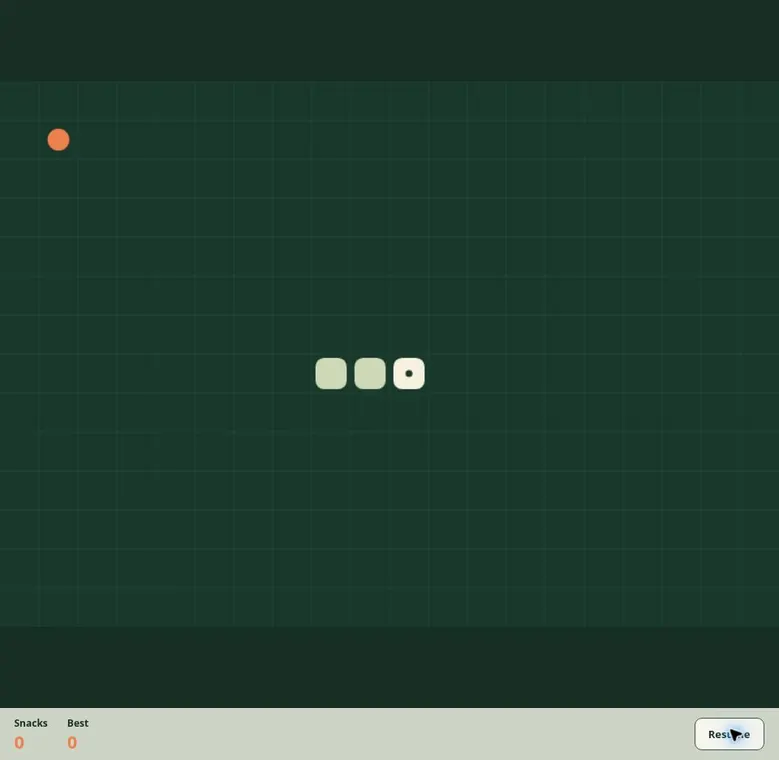 Snake Eating GameSolid walls. One snack at a time. A growing tail and faster turns.
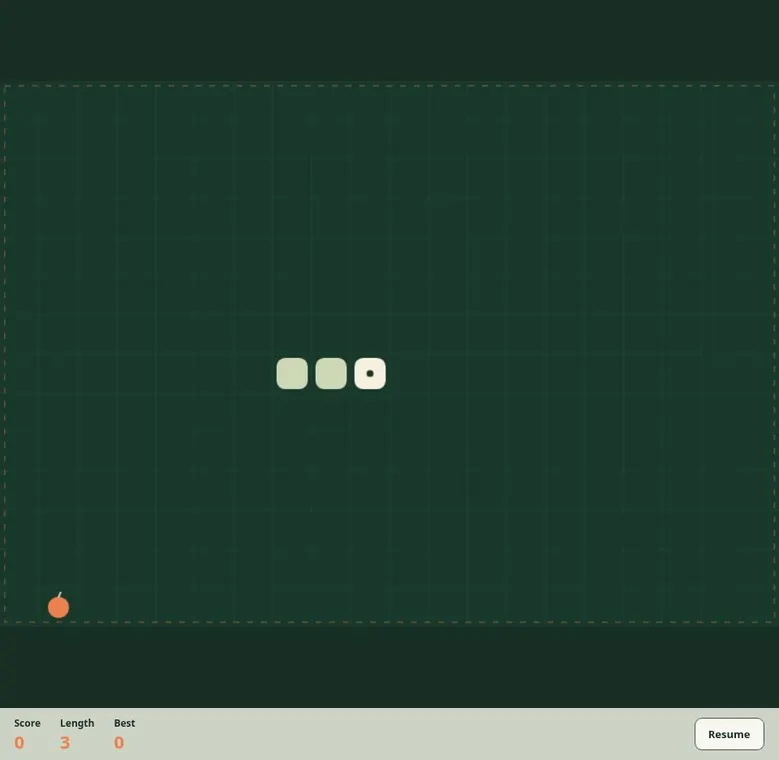 Snake Eating Fruit GameWrapping edges. Apples, bananas and short-lived berries.
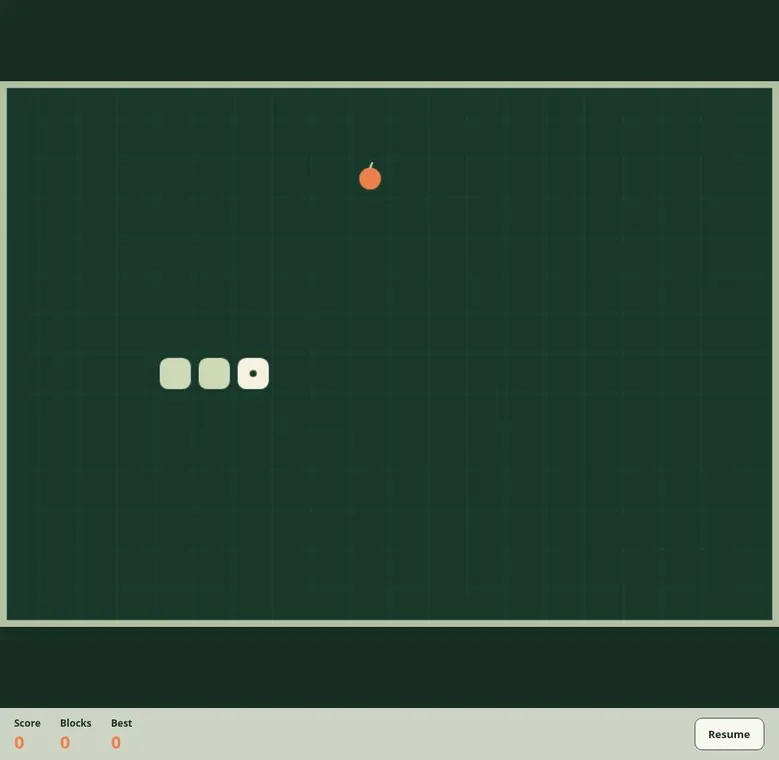 Snake Eating Apple GameSolid walls. One apple at a time. A new block every five apples.
Snake Eating Game: classic walls and a growing tail
The classic Snake Eating Game uses a twenty-by-fourteen-cell board. Your snake moves automatically, and you steer it with arrow keys or W A S D. On phones, swipe the board or use the visible direction buttons. Every snack collected adds one body segment and increases the snack counter. The next snack appears in an empty cell; its position cannot be memorized in advance.
In this version, running into a wall or crossing your own tail ends the round. The snake also speeds up as it grows, so open paths that feel easy at the beginning get harder later. You can pause with P or the on-screen control. For a first attempt, aim for a clean path around the board instead of weaving across your own body. If you enjoy a traditional, unforgiving arcade challenge, this is the best starting point.
Snake Eating Fruit Game: wrapping edges and fruit values
In Snake Eating Fruit Game, the walls are not deadly. Passing through the left edge brings your head back from the right, and crossing the top loops you to the bottom. That gives you new routes to reach food, but your own tail is still dangerous. Avoid steering into the space where your head will reappear.
This version has more variety in its food. An apple earns one point, a banana earns two, and a berry earns three. The berry disappears after about seven seconds if you miss it, making quick route planning worthwhile. You do not need to chase every berry: a short, safe turn toward another fruit can be better than a desperate turn through your own body. Choose this game if you prefer planning routes across open boundaries rather than dodging walls.
Snake Eating Apple Game: an orchard with permanent obstacles
The Snake Eating Apple Game is the option for players who want a finish line. Eat twenty-five apples to clear the board. There is only one food type, and each apple adds one point and one segment to your snake. The walls stay solid, so crossing an edge ends the round rather than wrapping to the other side.
Every fifth apple before the finish adds a permanent block and increases the movement speed. That makes the approach to apples five, ten, fifteen and twenty a useful moment to check your exit route. A newly placed block does not move away later. Do not plan a return trip through a square once a block occupies it, and keep an alternative route open before collecting the next apple. Pause when you need to inspect the board; a pause gives you time to think without changing the obstacles.
Start with this version if you already understand solid-wall snake and want a short, countable target. Start with classic instead if you are still learning to turn before the boundary. The apple game rewards space management as well as food collection: surviving one more turn can matter more than taking the closest apple immediately.
Which Snake Eating game should you play first?
- Prefer strict arcade rules? Choose Snake Eating Game: one snack type, solid walls, and a round that ends on wall or self-collision.
- Want multiple food rewards? Choose Snake Eating Fruit Game: three fruit values, a disappearing berry, and a board that wraps.
If this is your first round, choose one rule to practise rather than switching games after every mistake. In classic snake, practise leaving room between the head and the boundary. In the fruit game, watch the opposite edge before wrapping, because that is where the head will return. In the apple game, check which lanes remain open after each new obstacle. These are different problems, so a score from one version is not a useful target for another.
When changing versions, read the wall rule before pressing start. The same direction input can be safe at a fruit-game edge and fatal in either solid-wall game. Use the pause button to inspect an unfamiliar board, and begin another round when you want to practise the same turn again.
Playing on a phone or computer
All three snake games accept keyboard arrows and W A S D on a computer. They also provide direction buttons for phones. The play area scales down on smaller screens, but the important difference remains the same: classic walls end a round, while fruit-game edges loop. Use the fullscreen button on the game page if your browser supports it and you want more space.
Each snake game opens on its own browser page, without requiring a separate app installation or an account to begin. On a phone, make one clear direction gesture at a time; rapid direction changes can cause the head to collide with the body before there is room to turn.
Questions about the collection
How is the fruit snake game different from the classic version?
The classic game has solid walls and one snack type. The fruit game wraps through all four borders and awards different points for apples, bananas, and berries. In both, colliding with your own body can end the round.
What happens when a snake reaches a wall?
In the classic game, the round ends. In the fruit variant, the snake comes back from the opposite edge, but colliding with its own body still ends the run.
Is the best score shared between all games?
No universal cross-game leaderboard is offered here. Each game has its own scoring and browser-based record behavior, so compare your results within the same game rather than between different rulesets.
How to improve your snake route planning
Start with the board edges and think about where your tail will be after your next two turns. A snack might be close in distance but difficult to approach once your own body blocks the direct path. Build a wide route through open cells rather than crossing your previous path over and over. In the classic version, leave one or two empty squares before turning at a wall. In the fruit version, look at the position where you will re-enter after wrapping across a border.
As a snake grows, the same short path takes up more of the board. Try to travel in longer straight sections when they are available, and delay entering narrow spaces until your tail has moved out of them. If the fruit is near your body, check whether the space behind that fruit leads somewhere safe. Grabbing a reward at the end of a dead-end corridor can leave you with no escape on the next step.
Choose by pace and type of challenge
Classic Snake Eating Game is a good choice when you want a clear failure condition: hit the boundary or your own tail and the round ends. Its predictable walls make it easy to understand why a turn went wrong. Fruit Snake Eating Game removes wall collisions, but the wrapping boundary introduces a new way to misjudge your position. Higher-value berries may disappear before you get there; it is reasonable to ignore one if reaching it would send you into your tail. Choose the variant based on what you want to practice, not an assumed shared leaderboard.
Not a snake game: the classroom edition
Looking for the Sneak Eating Classroom Game? It is a separate stealth-timing game about secretly eating snacks while a teacher watches the room, not another snake variation. It has its own instructions and a dedicated classroom strategy guide.
Ready to begin? Play classic Snake Eating Game or switch to Snake Eating Fruit Game for the wrapping-edge variant.