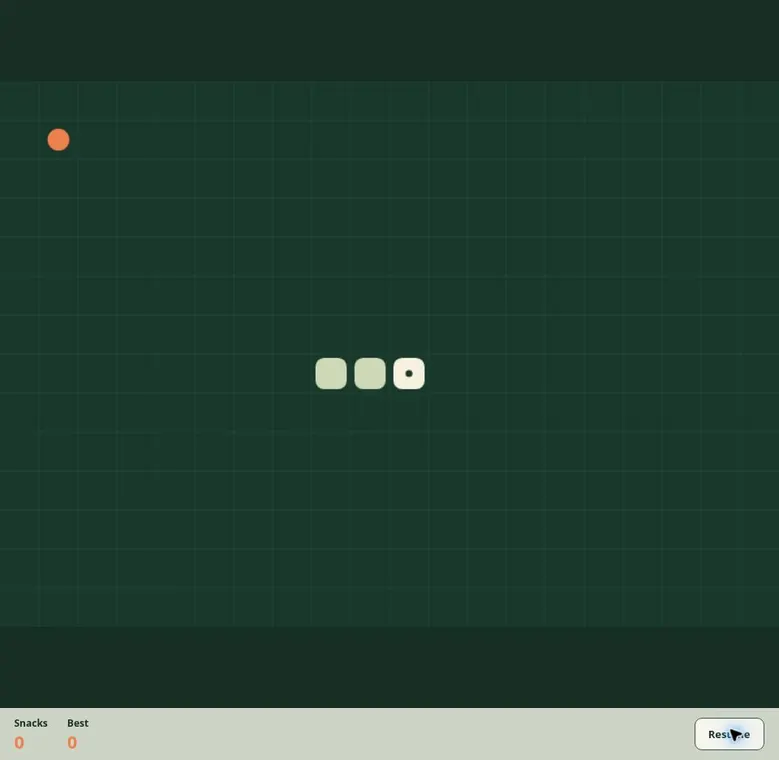
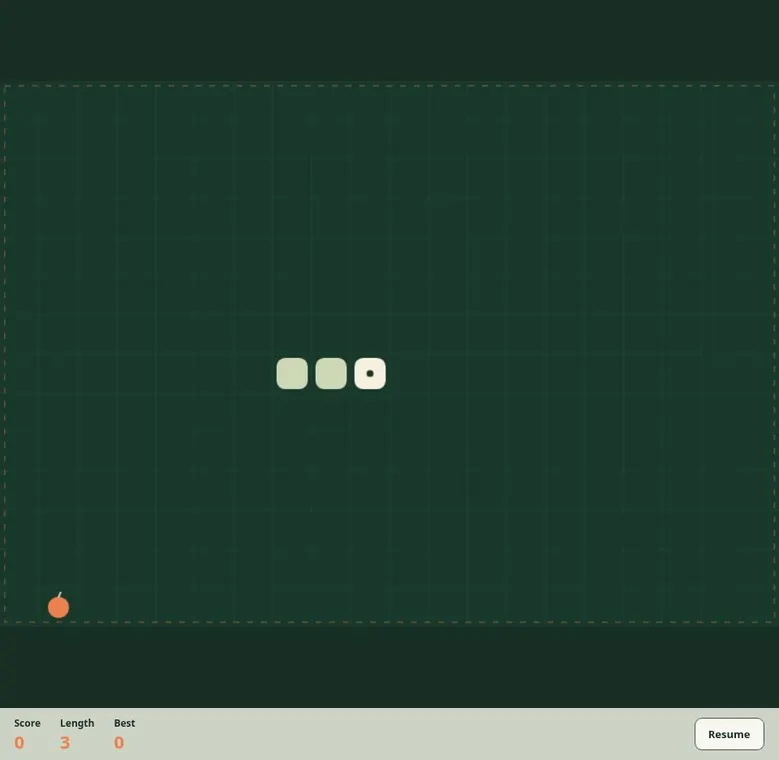
The Snake Eating Apple Game is the strictest board on this site: solid walls, one kind of fruit, and a new block every five apples that you can never move or cross. Eat twenty-five apples and the orchard is cleared. That makes it the tightest of the three snake games here, and the one that punishes a lazy route fastest.
How to play the Snake Eating Apple Game
Press the play button on the board and the snake starts moving to the right. On a computer the arrow keys or W A S D turn it, P pauses, and the fullscreen button in the toolbar gives you a bigger board. On a phone or tablet, swipe anywhere on the board or tap one of the four arrow buttons underneath it. The snake never stops on its own, so decide your next two turns before you reach the corner you are heading for.
Every apple is one point and one extra body segment. A round ends the moment your head touches a wall, a block or your own tail. There are no lives, no timer and no wrap-around on this board, and only one apple is on it at a time, in a random empty cell, so no two runs are the same.
What happens every five apples
The game attempts to add a block at five, ten, fifteen and twenty apples. It picks the farthest eligible open cell, at least three grid cells from the head and with no body segment directly beside it. Each placed block shortens the time per step by 10 milliseconds. Blocks do not move, do not expire and cannot be eaten. If the board has no valid space left for one, that block is skipped.
| Apples eaten | Blocks if every placement succeeds | One step takes |
|---|---|---|
| 0 – 4 | 0 | 175 ms |
| 5 – 9 | 1 | 165 ms |
| 10 – 14 | 2 | 155 ms |
| 15 – 19 | 3 | 145 ms |
| 20 – 24 | 4 | 135 ms |
| 25 | Up to 5 | Clear immediately, with no more turns |
That is the whole difficulty curve: the board loses usable space every five apples while your head moves faster, so the last five apples are played on a board that is both smaller and quicker than the one you started on.
Apple Snake board at 5, 15 and 25 apples
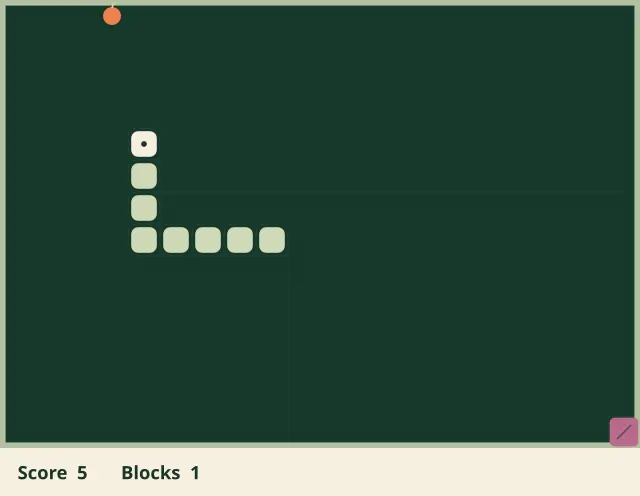
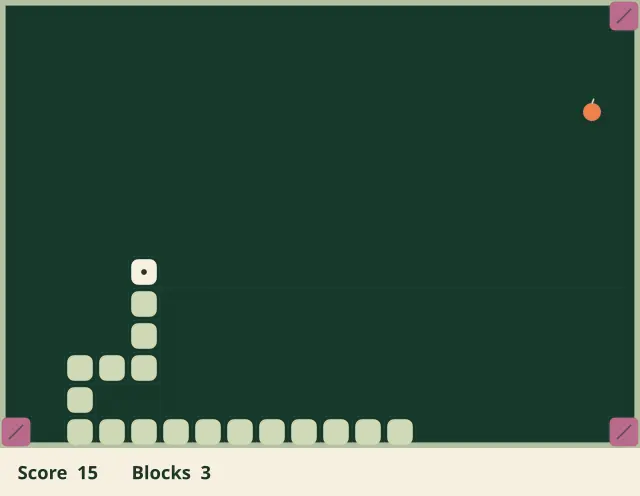
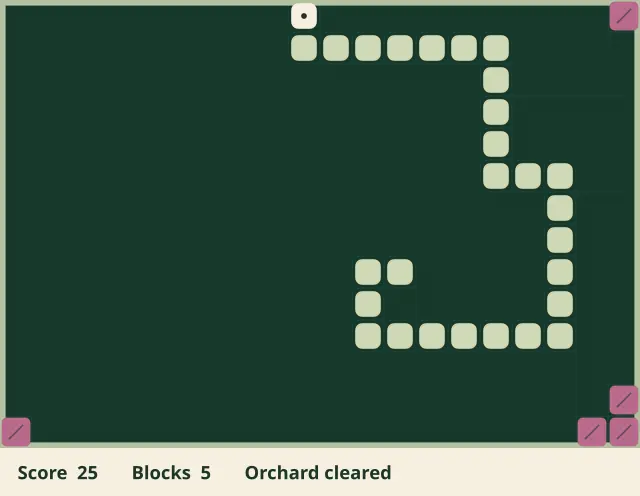
For a turn-by-turn example and late-round tips, read the guide to clearing all 25 apples.
Tips that change your score
- Expect the block one apple early. Plan the route to apples five, ten, fifteen and twenty as if the new block were already there, and its landing spot stops being a surprise.
- Keep the middle open. A new block is placed as far from the head as the rules allow. After each milestone, scan the opposite side and keep at least two open lanes between the center and the edge.
- Turn a cell before the wall. A step takes 175 milliseconds at the start and 135 with four blocks on the board. Turning at the last possible cell works at the start and stops working later.
- Approach apples from the middle. Coming at an apple from open space leaves your new segment trailing behind you; coming at it along a wall leaves that segment pinned in the corner you need next.
- Do not hug the border. A wall-hugging snake plus one block in a corner is a dead end with nowhere to turn. Keep at least one lane of empty cells between your body and the wall.
Three snake games, three rule sets
The classic Snake Eating Game is the plain version: solid walls, one snack at a time, a longer tail and a faster board, but no extra obstacles ever appear. The apple version you are on adds the blocks and a finish line at twenty-five apples. Snake Eating Fruit Game goes the other way: nothing can be hit at the edge, the board wraps, and apples, bananas and a short-lived berry are worth different points. If you want to practise clean turning without walls to worry about, play the fruit board first; if you want a clear, countable goal, stay here.
Sneak Eating Classroom Game is not a snake game at all — it is a timing game about eating snacks while a teacher is watching, with its own classroom strategy guide. You can compare every mode on the Snake Eating Games collection page.
Which Snake Eating Game should you play?
| Game | Edges | Obstacles | Goal |
|---|---|---|---|
| Classic | Solid walls | Your growing body | Beat your snack count |
| Fruit | Wrap to the opposite side | Your growing body | Score with apples, bananas and berries |
| Apple | Solid walls | Your body and blocks added every fifth apple | Eat 25 apples to clear the orchard |
Compare all three Snake Eating Games.
Between rounds
Your best apple count is saved in this browser, so a new round is never quite a blank slate. At twenty apples, check whether the fourth block closes a lane you had been using. If a route worked for you, leave the apple count and the pattern in the comments below — one concrete route teaches other players more than any list of tips.
Snake Eating Apple Game: quick answers
Is the Snake Eating Apple Game free to play?
Yes. It runs in your browser with no download and no account, and the arrow buttons under the board work on a phone.
What ends a round?
Touching a wall, one of the blocks, or your own tail. There are no lives and no timer, and the edges of this board do not wrap.
How many apples do I need to clear the orchard?
Eat 25 apples. The game tries to add a block at 5, 10, 15 and 20 apples. At 25, it attempts one final placement and immediately records the clear, so you never have to navigate the fifth block.
Can a new block appear on top of my snake or right in front of it?
No. A block is placed in open space at least three cells away from your head and never next to a body segment, and the snake speeds up one notch at the same moment. If the board has no valid space left, that block is skipped.
How is Apple Snake different from Classic Snake?
Both have solid walls. Apple Snake adds permanent blocks and ends in a clear at 25 apples. Classic Snake has no added blocks and lets you keep chasing a higher snack count.
Does it work on a phone or in fullscreen?
Yes. Swipe the board or tap the arrow buttons underneath it, and use the Fullscreen button in the toolbar for a bigger board.
How do I turn the snake?
Use the arrow keys or WASD. On a phone, swipe or tap the arrow buttons. You cannot reverse straight into the segment behind you.
How long does one round take?
There is no time limit. The round lasts until you collide or collect 25 apples, and you can pause with P or the Pause button.
Which block ended your best run?
Share the apple count you reached and where the board closed in on you. Keep personal information and links out of your comment.
No notes yet. Be the first to leave one.